Monetary Policy Loosens

by Thomas Cooley, Charlie Nusbaum, and Peter Rupert
Much has happened since our last post. The US-China trade war intensified as the Renminbi was allowed to fall 2% in three days, the European Central Bank set rate targets deeper in negative territory, and a new quantitative easing program was announced with a bond purchasing target of €20 billion per month.

Moreover, the ECB staff projections suggested a worsening of the overall EU economy. The GDP growth estimate for 2019 was dropped to 1.1% from 1.2% and for 2020 from to 1.4% to 1.2%. Inflation forecasts are 1.2% this year, 1.0% in 2020, and 1.5% for 2021.

There was significant dissent among the members over the sharp change in monetary policy. Governor Draghi’s decision provoked widespread dissent, and led the German member of the executive board to resign in protest. The committee also made it pretty clear that monetary policy alone will not be enough, quoting the report from the last meeting:

Finally, all members agreed that, in view of the weakening economic outlook and the continued prominence of downside risks, governments with fiscal space should act in an effective and timely manner. In response to the significant risks related to geopolitical factors, the rising threat of protectionism and vulnerabilities in emerging markets, policies other than monetary policy would be more effective and were better suited to address country-specific shocks. In this context, the Governing Council should communicate carefully so as not to create unrealistic expectations about the contingencies that monetary policy was able to address.

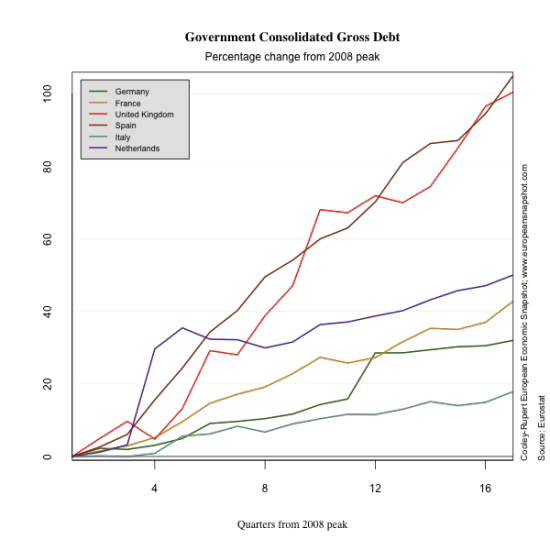
While many European economies seem capable of sustained fiscal stimulus, the vast majority are relatively small. Among the larger economies, only Germany and, to a lesser degree, the United Kingdom appear positioned to loosen their purse.

All of this begs several questions. How are the largest economies fairing? How effective is European monetary policy? What more can be done? Let’s dive deeper into these questions.

What do the data say?

Real GDP growth throughout the EU continued to decline during 2019Q2. Year-on-Year quarterly growth in Italy remains just above 0.0%, whereas French and German growth fell to 1.38% and 0.41%, respectively. The downward trajectory for Germany is particularly troubling given that it is the largest economy in the EU. Spanish growth also declined, albeit to a lesser degree, to 2.03% while growth in the United Kingdom remained steady at 1.22%. Growth in the EU has a whole declined to 1.37% from 2.26% this time last year. The decline in the Euro Area is even larger, from 2.26% to 1.15%.

While it is the case that some countries have experienced quite high year-on-year growth, it has been concentrated in the smaller European economies.

While the above pictures already spark alarm, the annualized quarter-on-quarter growth rates are even more concerning. Quarterly growth in the EU28 has fallen remarkably during 2019Q2, from 2.0% to just 0.7%. Much of this decline is driven by the two largest European economies: Germany and the United Kingdom. The annualized quarter-over-quarter growth rate for each was -0.30% and -0.77%, respectively. Both are large contractions.

Unemployment remains low across much of Europe. Indeed, the unemployment rate in Germany and the United Kingdom reached 3.1% and 3.8%, respectively, in 2019Q2. Still, the unemployment rate in the next three largest economies–France, Italy, and Spain–are some of the highest in Europe. The EU28 as a whole lags far behind the United States along this dimension with an unemployment rate of 6.3%. Euro Area unemployment is roughly double that of the United States, with 7.6% of their labor force without work.

Moreover, investment growth, as measured by changes in real fixed capital formation, has all but ceased in the United Kingdom. Spain is not far behind. Italian investment growth, partially rebounded since 2018Q4, also appears tepid. Despite serious concern in 2018Q2, both the EU28 and Eurozone have outpaced the United States, experiencing investment growth of 2.5%, 2.8%, and 1.9%, respectively.

Market participants seem to have recognized some of these signs of slowing and have adjusted their expectations for future growth downward. Here, we use the spot rate yield curve as a proxy for market expectations. Typically, a higher rate is demanded for long term bonds than for short term bonds. The reasoning is simple: Both the opportunity cost and risk associated with long-run inflation and potential default are greater for long times to maturity than for short term bonds. As pessimism about the immediate future grows, capital shifts from equities to long-term bonds in the hopes of riding out a potential recession and market rates fall.

Relative to the prior two years, the yield curve in the Euro Area has begun to flatten. Indeed, yields on bonds of almost all maturity lengths have decreased and turned negative as of 2019Q3. The largest changes occurred for long maturity bonds, with the yield on 30 year bonds falling over 1 percentage point over the past year. In contrast, the slope of the yield curve remained fairly steady between 2017Q3 and 2018Q3.

While the previous picture is quite striking, the Q3 yield curve remains steeper than that in the United States. Whereas the average slope between 1 year and 10 year, and 1 year and 30 year bonds in the Euro Area is positive, only the latter is true in the United States. Still, the degree of change displayed above highlights growing market concerns.

Despite maintaining a negative rate target since June 2014, Euro Area inflation has remained far below that in the United States and the ECB’s inflation target of 2%. In fact, there has been little movement in average Euro Area inflation since 2014Q1 with the exclusion.

Another complicating factor is EU-US trade relations. The polices put in place by the ECB have been putting pressure on the Euro.

What has the ECB signaled?

With target interest rates steadily falling and little adjustment in average Euro Area inflation, the threat of deflation looms large on the ECB’s decisions. Incoming ECB President Christine Lagarde has said as much in the past: “If inflation is the genie, then deflation is the ogre that must be fought decisively.”

The outgoing ECB President appears to agree. According to Draghi the open-ended QE policy will be functioning “as long as necessary to reinforce the accommodative impact of its policy rates.” This left the timing and size to be determined as the data pour in. This is more like “open-ended forward guidance,” that is, “What data will be the determining factors?” The stage appears set for even further monetary stimulus moving forward.

Historical Consequences of Monetary Policy

But to what degree has the ECB succeeded in the past? The rate cutting behavior of the ECB is designed to boost the economy through increased consumer spending and a rise in loans issued by banks. The link between monetary policy and consumer spending appears to have weakened in recent years. Indeed, household consumption growth has slowed in many economies.

Instead, households have increased their deposits. The ECB reports that deposits held by financial institutions has shown a consistent upward trend since 2010. This is in despite of gradual rate cuts by the ECB.

On the other hand, the loan channel of monetary policy has succeeded to a degree. While loans to non financial institutions have declined relative to deposits held, the situation has improved since target rates entered negative territory in 2014. Still, achieving even such modest expansion of loans has required rather extreme rate targets.

Moreover, the rate cuts during 2011 appear to have reduced overall systemic risk of the financial sector and the probability of large scale defaults. It is unclear, however, if this correlation has persisted since 2014. Despite continued monetary policy loosening, the chance of systemic default has changed little. The reductions in systemic risk suggested by the figure below can only tell us so much. We do not know if this reduction is artificial or a sign of a healthier financial sector. It could very well be the case that loose monetary policy is simply hiding inefficiencies and otherwise be poor performance.

Our Take

Aggregate growth across Europe has clearly slowed and market optimism has decline remarkably over the past year. Concern within the European Central Bank is certainly warranted. It is not clear, however, how effective loosening monetary policy further will be. Despite crossing the so called “zero lower bound” and entering negative territory, inflation remains well below 2% and household deposits are growing at their fastest since 2010Q1.

This failure of rate reductions is likely the cause of the ECB re-instating its quantitative easing program. Such a program is not without its own inherent risk. Evidently, traditional policy tools have failed and so it is not clear what effect new QE will have. The ECB will eventually need to reduce its balance sheet and offload its assets. Expanding its balance sheet either too early or to little effect will only exacerbate the pain of tomorrow. To us, a not so simple question must be answered: Has European monetary policy reached its limit?

Deal or No Deal: Still No Sign of Brexit

by Thomas Cooley, Charlie Nusbaum, and Peter Rupert

It has been almost three years since some of our British friends voted to leave the European Union and forge ahead on their own. Many discussed the potential economic ramifications of leaving the EU leading up to the vote. From immigration to trade to capital investment, Brexit was meant to be disastrous for the Brits. Since the initial vote, much has happened. Theresa May both became Prime Minister and faced a “No Confidence” vote, large scale protests both for and against another referendum have erupted, and May’s Brexit deals have been rejected by the British Parliament on three occasions. Now, the deadline for a No Deal Brexit has been extended to October 31 as talks have broken down and Theresa May has announced that she will step down as Conservative Party leader. Throughout these negotiations and despite its political uncertainty, the United Kingdom kept pace with many of its major European neighbors and has even outperformed over the past 9 months.

Average year-over-year growth among Europe’s largest economies has remained just below the US average of 2.2% since the start of 2016. During the end of 2017 and beginning of 2018, however, growth in France, Germany, and Italy began to decline, reaching 1.1%, 0.7%, and under 0.1%, respectively, for 2019Q1. We have attributed this decline to political uncertainty in previous posts. With early general elections and the rise in the Catalan Independence Movement in Spain, and Brexit looming over the United Kingdom, we would have expected these two to experience a similar slowdown. Instead, however, both have remained largely insulated, with Spanish and UK growth reaching 2.4% and 1.8%, respectively. Both ticked up from 2018Q4.

We can attempt to uncover the affects of Brexit more rigorously by estimating the probability that there has been a break in long-run growth. In the above graph, we use Bayesian methods to estimate this probability and restrict our attention to after the Great Recession. Two empirical facts are immediately evident. First, our regression model estimates a high probability of a change in the long-run growth rate for all countries during the recovery. Second, our regressions indicate that it is very unlikely–almost 0 probability– that long-run growth in these economies has changed since then. The exception to this is Spain, where our model predicts a high probability that a trend break occurred during 2013Q1 due to its persistent rise around this time. Still, Brexit does not show up anywhere in terms of a trend break.

Investors also seem to have confidence that the recent events of Brexit are little to worry about. While an imperfect measure, here we use stock returns as an indicator of market expectations. Several features are apparent. First, there was a large drop in returns leading up to 2016 and again prior to the Brexit vote. Second, returns in the EU have experienced a persistent decline since the start of 2017. Finally, and most notably, large declines in European returns track declines for the Dow Industrial Average quite closely. If Brexit were a first order concern of investors moving forward, we would expect to see sharper movements in European markets than in US markets, particularly in the FTSE 100, around key Brexit deadlines. At most, it seems as though Brexit is already baked into market expectations.

Are the negative effects of Brexit and uncertainty surrounding it hidden elsewhere? Not as far as we can tell. Below is a striking graph of real household consumption growth. Whereas real consumption growth has declined substantially across Europe’s largest economies since 2016, the United kingdom has maintained a year-over-year consumption growth of between 1.6% and 2.0% since initially dropping below 2.0% in 2017Q3. France, Italy, and, until this quarter, Germany saw consumption grow by only around 0.5%. Spain has recently suffered weak consumption growth, falling from 3.0% in 2018Q1 to 1.4% in 2019Q1. Still it remains well above France and Germany.

Moreover, trade has been largely unaffected by the developments surrounding Brexit. In fact, none of the four largest economies– France, Germany, Italy, and the United Kingdom– have seen a change in trading behavior. Exports both to their EU trading partners and the United States have continued their long-term trends since at least 2010, or in the case of the United Kingdom, 2015.

Imports among these economies tell a similar story. One major difference in these pictures is that UK imports of US goods has steadily risen since the beginning of 2018 after remaining largely constant for the three years prior. Still, given that France, Germany, and Italy have seen very little change to their trends in trading behavior, and given that the UK has also seen a large increase in imported goods from the rest of the EU, it is difficult to identify any effects of Brexit.

There is one place where we may– and we stress the word “may”– be beginning to see the effects of Brexit. Since 2018Q1 Germany, France, and Spain have largely maintained average investment growth as measured by fixed capital formation of 2.8%, 2.8%, and 5.2%, respectively, while the United Kingdom has had almost no increases in investment of late. This past quarter, however, UK investment growth risen above the US average of 1.2% to 1.7%.

Final Take

While the largest European economies have seen quite substantial declines in both GDP and household consumption growth, the United Kingdom has remained steady. This is in spite of the uncertainty surrounding their future. It is hard for us to point to a single picture, or collection of pictures, to see Brexit effects. We challenged ourselves to imagine that we did not know when Brexit, and the subsequent political turmoil, occurred and tried to guess when it happened using these data. We couldn’t. Can you?

Signs of Slowing

by Tom Cooley, Charlie Nusbaum, and Peter Rupert

For several quarters now, there have been signs of trouble for many European economies, including the biggest ones. In earlier posts we highlighted the impact that trade and policy uncertainty may have on growth (here) and the strain that weak banking sectors place on European economies (here). Some of these concerns have been realized. But which margins are most affected by this slowdown? As is evident below, however, this phenomena seems to be concentrated in the Western European economies. Hence, we focus on Europe’s four largest economies to investigate this question.

In our country pages, we discussed the 2011-2013 slowdown extensively. From 2013 to mid 2017, the “Big Four” began accelerating in terms of growth. Growth in France, Italy, and Germany maintained an upward trend during this time period. After 2017Q4, however, growth trends for these three have reversed in remarkable fashion. Indeed, year-over-year GDP growth in France, Germany, and Italy has fallen by 1.9, 1.2, and 0.9 percentage points, respectively, over the past year. The United Kingdom has not faced the same type of trend reversal. Instead, year-over-year growth in the United Kingdom has slowly declined from its 2014Q4 peak of 3.07%. The UK slowdown continued this quarter, with year-over-year growth falling to 1.33%.

Short term growth for these economies presents a similar picture. While quarterly GDP growth in the UK has shown moderate declines over the past 3 years, that of France, Germany, and Italy shows a more sharp decrease. In fact, Italy has posted negative quarterly growth of -0.13% and -0.22% during 2018Q3 and 2018Q4, respectively. Germany “rebounded” from its -0.20% quarterly growth in 2018Q3 to 0.02% in 2017Q4. While CEPR adopts the NBER view that two-consecutive quarters of growth does not itself constitute a recession, the performance of these countries over the past two quarters will almost certainly be a focus for CEPR’s Business Cycle Dating Committee given the optimism of their last report.

To determine which margins are most affected at this point in the slowdown, we rely on the expenditure identity:

Y = C + I + G + NX

Here, Y is output, C is personal consumption, I is investment, G is government consumption, and NX is net exports. Given that output growth has slowed, it must be the case that one or more of these values has also deviated from trend.

Personal Consumption

Household consumption is often one of the first signs of economic slowdowns. Indeed, recall the circular flow diagram. This simple diagram shows that all expenditures (output) are balanced out by an equal amount of income receipts similar to a T-account. As a result, declines in output should be reflected in declines in aggregate income and thus aggregate consumption, depending on marginal propensities to consume.

Below, we see that real household consumption has steadily risen for each of the Big Four since their most recent troughs. Excluding Italy, each country has more than recovered from the Great Recession. Italian personal consumption on the other hand remains roughly 3% below its pre-recession levels.

Growth in household consumption, however, seems to have slowed in Germany, France, and Italy. Consumption growth peaked in Germany and France in 2017Q2 and 2016Q4 at 2.44% and 2.18%, respectively. Both have seen persistent declines since. Italian consumption growth has also seen a sharp decline since 2017Q3 following a brief recovery in this measure between 2016Q4 and 2017Q1. United Kingdom consumption growth, on the other hand declined from a 2016Q1 peak of 3.32% to 1.65% in 2017Q3, but has remained just under 2% since.

Investment

A second potential sign of the downturn is a decline in investment. Below we show real fixed capital formation, a measure of fixed capital investment. Note that these 2018Q4 flash estimates for Germany and Italy are not yet available. Each country has shown persistent increases since their respective troughs. The United Kingdom has seen a decline in fixed capital formation beginning in 2017Q4.

Recent German and French investment growth peaked at 4.3% and 5.5% in 2017Q2 and 2017Q4, respectively, and has declined ever since. Italian investment growth remained on the rise until 2018Q3.

Investment in fixed capital has indeed showed signs of slowing. In the United Kingdom, it has even declined. Moreover, the timing of this decline coincides largely with the European growth slowdown. This suggests that declines in capital accumulation are in fact one important source of this slowdown.

Government Expenditure

Government expenditures have continued to increase in Germany and France. Italian and UK government consumption, on the other hand has remained constant since 2016Q1.

Despite continued increases, growth in German and French government consumption has declined. The starkest growth decline is in Germany, which has fallen from its peak of 4.78% in 2016Q2 to 1.73% in 2018Q3. The deceleration of French government consumption began more recently, decreasing from 1.52% in 2017Q3 to 0.92% in 2018Q4.

These declines in government expenditure growth may be an effort to stabilize rising government debts, with the exception of Germany. Instead, Germany has steadily decreased the relative size of its public debt. The decelerating its government expenditures will certainly aid in continuing this trend.

Trade

Finally, declining output growth me be reflected in declines in net export growth. The graph below shows monthly exports between the Big Four European economies and China, the rest of the EU, and the United States. Excluding the United Kingdom, there is a persistent upward trend in exports among these countries and their trading partners. UK exports experienced large gains in 2013 and 2014, but leveled off shortly thereafter. Germany has experienced the smallest growth in exports, but also the least volatility in its exports throughout the period.

Net exports display a similar story. Here, a negative index implies a trade deficit for that month whereas a positive index indicates a trade surplus. Here again, net exports are largely trending upwards and at least not decreasing by a substantial degree. The exception is the United Kingdom, where net exports with all of its trading partners have shown a slight downward trend.

Taken together, these pictures do not yet show any clear signs of the economic slowdown. Given that there do not seem to be deviations from trend beginning around 2017Q4, we conclude that trade has not yet been affected by the downturn.

The Labor Market

While not explicitly found in the expenditure approach equation, the circular flow diagram shows that labor markets are tightly linked to output fluctuations. Below, we show the employment to population ratio for 20-65 year olds. Note that only 2018Q3 data is currently available for this measure. The employment to population ratio has been on the rise in all countries. Germany and the United Kingdom boast the largest relative working population with employment to population ratios of 79.7% and 78.6%, respectively. Italy is weakest in this regard with only 63.1% of 20-65 year olds maintaining employment. Of note is that there have been no significant deviations from trend over the past year among the Big Four.

A direct corollary of these trends is the fact that the unemployment rate has continued to fall. While there has been a slight uptick of 0.1% in the United Kingdom and a leveling out in France, the unemployment rate in Germany and Italy has continued to decline.

One key friction in labor markets is that it takes time to find work, leading to structural unemployment. The rate at which those searching for jobs receive offers may discourage “marginal searchers” from participating in the labor force. One way to investigate worker-firm matching in the labor market is through a Beveridge Curve, which plots the job vacancy rate against the unemployment rate. Economic theory tells us that the higher the ratio of vacancies to unemployed job searchers, the higher the arrival rate of job offers.

Below we show the Beveridge Curve for the EU excluding the United Kingdom as more historical data is available than for the EU28. The graph is qualitatively identical for the EU28. Data limitations force us to rely on the EU as a whole as a proxy for the Big Four. Clearly, this Beveridge Curve indicates that the vacancy rate is very high relative to the unemployment rate. Notice, however, that the red portion of this curve has shifted outward relative to pre-2013 data. This indicates that match efficiency in the labor market has declined. That is that for any particular vacancies to unemployment ratio, there are fewer worker-firm matches. This decline in match efficiency may reflect a number of things such as differences in the skills required by job openings and those searching for work, geographical mis-match between the unemployed and vacancies, etc.

Despite the decrease in match efficiency, however, it is difficult to see the recent downturn in this picture. Taken together these pictures suggest that the labor markets of these four economies have remained largely unaffected by the growth slowdown.

Final Take

France, Germany, Italy, and the United Kingdom have all experienced a sudden slowdown in growth over the past year or so. The effects of the slowdown (or even negative growth in some cases) have already shown themselves in household consumption and to a lesser degree, investment growth. Trade and the labor market have largely remained unaffected so far. It is unclear, however, whether these two markets are robust to the source of this current slowdown or that their fragility is masked in current data.

Several factors contribute to our anxiety. Europe, like the U.S., is faced with large sources of uncertainty. Brexit continues to cast a long shadow, Italy’s GDP growth has been in negative territory and government debt is becoming increasingly problematic at about 130% of GDP. The rise of populist governments has splintered the fragile consensus about the European vision. Increasingly the monetary union feels like a straight-jacket to some of the underperforming economies. One thing is certain: the next few years in Europe will be interesting to watch.

Trade and Politics Start To Take a Toll

By Thomas Cooley, Charlie Nusbaum, and Peter Rupert

European Politics

During the first quarter of 2018, the EU has been marred by both political and economic uncertainty. Increasing tensions between the U.S. and its European allies have resulted in the looming threat and subsequent imposition of trade tariffs. Moreover, Germany and Italy, the largest and fourth largest economies in the EU, respectively, were struck by the emergence of the populist, Eurosceptic wave washing over Europe. Indeed, the Social Democratic Party polled its lowest during the German election since World War II whereas the Alternative for Germany party, the nationalist insurgency, gained entry into the Bundestag for the first time with the third largest number of votes. Angela Merkel’s Christian Democratic Union party lost a total of 55 parliamentary seats. Despite the conclusion of the German elections in late September of last year, a formal coalition was not formed until March.

In Italy, a similar story played out during 2018Q1. In late December, President Sergio Mattarella dissolved the parliament and called for new elections to be held in early March. In the run-up to the election the Five Star Movement, a right wing populist party which has supported abandoning the Euro and leaving the EU at various times, surpassed the consistently pro-Europe Democratic Party to take the top spot in opinion polling while Lega, the more fervent anti-Europe party, maintained its fourth position in such polls. The results of the election showed the Five Star Movement winning the popular vote and Lega placing third.

Uncertainty surrounding Brexit, however, lessened as the deadlock in the first round of negotiations broke. In fact, the United Kingdom entered 2018Q1 having just reached an interim agreement surrounding three key issue: free movement across borders, the rights of UK citizens abroad and EU citizens in the UK, and a financial settlement to be paid to the EU. While preliminary, it served as an important step in resolving some of the uncertainty surrounding the crucial transition period of the Brexit process.

The resolution surrounding Brexit was rewarded by the markets with all four major stock indices in the EU seeing gains towards the end of the year. These gains were quickly lost, however, when it became clear that the uncertainty surrounding tariffs, Italian elections, and the formation of a coalition among Germany’s major political parties were a potential threat to Europe. In fact, all four indices showed largely horizontal movement throughout 2018Q1. These trends beg the question: Is the European economy robust enough to withstand such bouts of uncertainty?

Economic Growth

Overall, the EU28 and EA19 both saw a minor slowdown in growth during 2018Q1, ticking down from 2.71% and 2.83% during 2017Q4 to 2.43% and 2.54%, respectively. Moreover, both were outperformed by the U.S., which saw a year-on-year growth rate of 2.78% according to the BEA’s second estimate. The Eastern European countries by and large outperformed the rest of the EU, while Cyprus continued to break from its Greek neighbors and boasted year-on-year growth above 3.5% for 6 straight quarters. This is quite a turnaround for the small European island given that just four years ago it struggled to pull itself out of a two year contraction. On the other hand, the four largest economies in the EU underperformed.

Indeed, France, Germany, Italy, and the United Kingdom all saw a decrease in growth during 2018Q1. For the United Kingdom, this continues a long term trend that began in 2015Q1 and was restarted during 2017 following the Brexit vote. For France, Germany, and Italy, however, this marks one of the first signs of weakening in this regard over the past year and a half.

Europe lagged behind the United States slightly in terms of investment growth with real fixed capital formation growing by 4.19% and 3.59% in the EU28 and EA19, respectively, compared to 4.45% in the U.S. Here again, the Eastern European countries fared best while Cyprus saw a severe contraction in investment. Going forward, this trend may inhibit Cypriot growth and break its impressive streak of exceptional growth.

The Unemployment rate in most European countries remained low during 2018Q1. Indeed, only Spain and Greece maintained unemployment rates above 10%, with values of 16.2% and 20.5%, respectively. Across the EU28, the unemployment rate decreased slightly to 7.2%. The European labor market remains behind the United States, which boasted an unemployment rate of only 4.1%, in this regard.

Still, the European labor market is heading in the right direction despite the uncertainty revolving around the European political status quo. Those countries whose labor market struggled the most continued their long run trends of declining unemployment. While Finland, France, and Italy have seen the least dramatic movement in unemployment, a slight downward trend still presents itself. Not pictured below are the first and second largest EU economies: Germany and the United Kingdom. Germany and the United Kingdom both display a similar downward trend, though they boast unemployment numbers of 3.5% and 4.2%, respectively. Both of which are on par with the United States.

As a whole, the EU labor market has shown persistent improvement. Indeed, the EU28 Beveridge curve continues to indicate ever increasing market tightness as is evident by the simultaneous decrease in unemployment and increase in the job vacancy rate.

A key comparative static of Beveridge curves are whether they display an outward or inward shift as they complete their loop. Here, it is clear that the Beveridge curve has seen a drastic outward shift between 2013Q2 and 2018Q1 as compared to the 2006Q1 to 2008Q1 period. This implies that the labor market requires a higher number of unfilled jobs in 2018Q1 than 2008Q1 in order to sustain the same level of unemployment.

An Uncertain Future

In spite of the political uncertainty throughout the continent, the EU largely maintained its positive growth. There are, however, some early signs that the perceived threats to the European experiment are beginning to have a real impact.

It is far too early to sound an alarm, but we take the recent data to be an early symptom that should be watched carefully. Trade policy between the U.S. and the EU is becoming increasingly strained as each side ratchets up tariffs, tension has emerged within the German coalition over legislative priorities and the refugee crisis, and a populist coalition between the Five Start Movement and Lega that many fear will place increased strain on Italy’s finances has taken power. Moreover, the United Kingdom and the rest of the EU must come to a final Brexit agreement in the coming months before the mid-October EU summit. While the EU has shown resilience to the early political events of 2018, increasing uncertainty and an escalating trade war will be a true test of the European economies.

Are Italian politics sabotaging the Monetary Union?

By Thomas Cooley, Charlie Nusbaum, and Peter Rupert

In the aftermath of the European debt crisis  much has been done to try to improve the safety and stability of the financial system.  It was clear that one key to financial stability was to complete the process of a banking union within the Eurozone (the EA19). To that end they have adopted a Single Supervisory Mechanism centered at the European Central Bank. In 2017 they implemented a Single Resolution Mechanism for addressing insolvent or illiquid banks. Question:  Is a Euro in an Italian Bank, as viewed by the market, the same as a Euro in a German Bank? Until the answer to that question is yes, the banking system remains fragile. A key ingredient to an affirmative answer is a Single Deposit Insurance system. So far the Germans have been steadfast in their opposition to unified deposit insurance for obvious reasons.  The balance sheets of banks in the third and fourth largest economies in the Eurozone carry a lot of legacy risks in the form of non-performing loans and a heavy exposure to the debt of the sovereigns.  We have documented these issues in earlier posts.  The only way out of this bind is for banks to improve the health of their balance sheets. We consider this next.

Stronger Banks in Europe?

One of the major concerns in the European financial sector during 2017Q1 was the mix of outstanding loans. During the first quarter of 2017, the ratio of non-performing loans to all outstanding loans in Greece, Cyprus, Ireland, Portugal, and several Eastern European countries signaled potential trouble ahead. At the end of 2017, these same regions remain the trouble spots in this regard. Indeed, 44.9% and 38.9% of loans from Greek and Cypriot banks are over 90 days past due. The remaining trouble spots have a non-performing loan ratio of 6.5%-15.2%. All of these countries, however, have improved their loan portfolios throughout 2017.

From 2017Q1 to 2017Q4, the ratio of non-performing loans to all loans in Cyprus and Greece has decreased by 4.9 and 1.3 percentage points, respectively. Throughout the EU28, the same decreased by 0.76 percentage points. The only two countries who saw their position worsen in this respect are Estonia and Sweden, though both remain below 2%.

The EU28 financial sector continued to improve its ability to cope with distress. As a whole, the EU increased its liquidity coverage ratio by just under 4%. While several countries saw a substantial decline in this measure, it does not give us pause.

Indeed, despite Sweden, Estonia, and Hungary’s large decrease in their liquidity coverage ratios, they all remain above the 148% coverage ratio in the EU as a whole. The only country not in compliance with the Basel III minimum liquidity requirement rule of 90% for 2018 is Greece, which held only 11% of its 30 day expected net cash outflows in high quality liquid assets. Excluding Greece, every EU member nation is already compliant with Basel III’s final liquidity requirement of 100%, which is set to go into effect next year.

Profitability remains an area of concern, however. As measured by return on equity, the profitability of European banks decreased by 0.78 percentage points. Despite this overall downward movement, over half of the EU28 beat out U.S. banks, which had a return on equity of 8.4% in 2017Q4.

The operating efficiency of European banks as measured by the cost to income ratio showed little change since 2017Q1 overall, decreasing by just 0.33 percentage points. As in 2017Q1, central European countries have some work to do to bring down costs. German and French banks remain the least efficient with cost to income ratios of 80% and 71%, respectively.

On the other hand, over half of European banking systems maintained cost to income ratios around 50%. For comparison, major U.S. banks range from 58% (Morgan Stanley) to 76.2% (Wells Fargo). While measures of efficiency differ depending on the ratio considered, virtually all fall within this range for U.S. banks.

 Inching Toward Stability

Despite the positive signs in many countries, caution remains to drawing an optimistic conclusion regarding the stability of European banks, particularly in the EA19. Two key points to stress are that participation and size matter. What do we mean by participation? Many of the countries that boast a healthy financial system have little relevance with respect to the a healthy monetary union. In fact, 3 of the 5 countries with the lowest NPL ratio are not members of the monetary union while 4 of the 5 countries with the highest NPL are members of the EA19. In addition, 4 of the 5 financial sectors suffering from low efficiency as measured by the cost-to-income ratio are Euro adopters. As a result, the positive trends emerging in Europe are deceiving.

Moreover, the performance of Eurozone banks must be weighted according to their respective sizes. While Italian banks are moving in the right direction, they maintain a cost to income ratio above 60%, a non-performing loan ratio of 11%, and a tier 1 capital ratio of just 13%. As one of the largest economies in the EU, this low performance carries much greater weight than the strong Luxembourg banks. Even more striking is the polarization between Germany, the largest economy among both the EA19 and EU28, and Italy, the 3rd largest EA19 and 4th largest EU28 economy, with respect to their TARGET2 balances.

The TARGET2 system was set up in 1999 as a payment settlement system between European banks. TARGET2 balances can be interpreted in two ways: as a reflection of current accounting financing or as a measure of the capital account. Prior to the financial crisis, TARGET2 balances remained roughly even throughout the the EU. Following 2007, however, German banks began taking on the role of primary creditor in the EU, whereas Italian banks assumed the role of primary debtors. Broadly speaking, these trends can be seen as a reflection of net capital inflow for Germany and net capital outflow for Italy. This picture presents a very clear message: a Euro held in Italian banks is not yet valued equally to one held in German banks. The same story emerges for Spain, the 4th largest economy in the EA19. Until an Italian or Spanish Euro is seen by the market as equal to a German Euro, we hesitate to claim that the European financial sector or EA19 are stabilizing.

While long term systemic shocks are always a concern, improved loan portfolios and high liquidity coverage ratios signal that European banks are improving their ability to cope with short term financial distress. In light of mixed profitability measures, sustained difficulty in Greece, and a persistent divergence of TARGET2 balances among the largest European economies, however, the ECB is right to maintain its holding pattern thus far in 2018 (here, here, and here) until the largest European economies signal stronger, more uniform improvement. Moreover, we see several challenges that must be tackled to resolve the fragility of the European Monetary Union. First, legacy debt and the size of non-performing loans in the larger economies have prevented a willingness on the part of well-performing countries to fully integrate their banking sectors with countries such as Italy and Spain. Reconciling these differences is of first order importance to promoting a sound and robust financial system. Second, a unified deposit insurance scheme must be implemented in the EMU. Until such a policy is implemented, it is difficult for us to see how or when market participants will value a Euro equally across all Eurozone banks.

Finally, recent political events in Italy have caused even greater concern over the state of the Monetary Union. Despite reassurances by Italy’s Economy Minister that it has no plans to leave the Euro, political parties espousing anti-Euro policies have gained a fair bit of traction in Italy with roughly 30% of the voters favoring such an exit (here). Should these policies continue to gain in popularity, it is not unimaginable that the EU could face an Italian BREXIT (exIT). Whereas Britain has always remained on the periphery of the Union, an Italian exit would strike at the heart of the Euro Area. Such a move on the heels of a BREXIT would make it difficult to see how the Eurozone, or EU for that matter, could survive in its current form. Indeed, Italian politics has the potential to make BREXIT look like a tea party.

Click here for an in-depth evaluation of the European banking system and the EMU from the 2018 “State of the Union Conference” held in Florence this past May. Skip to 1:53:30 to see remarks by Thomas Cooley.

New U.S. Snapshot Page!

We are pleased to announce that we have finished updating our partner blog: the U.S. Economic Snapshot. It should now give us the same flexibility in our data presentation as in the European Snapshot. We also hope to bring you more regional and state-level analysis in our future posts.

You can find the U.S. Snapshot at econsnapshot.com.  

A Strong End to A Strong Year

by Thomas Cooley, and Charlie Nusbaum, and Peter Rupert


The European Union finished 2017 strong with GDP growing at an annualized rate of 2.4% during Q4 and 2.6% throughout 2017. The Euro Area performed slightly better with a year-on-year growth rate of 2.7%. Both regions outperformed the United States, which grew by 2.5% during 2017. Moreover, 2017Q4 remained largely on par with 2017Q3, though with a substantial increase in gross fixed capital formation. Whereas fixed capital formation decreased at an annualize rate of 0.80% during 2017Q3, it rebounded during 2017Q4, growing by 3.6%.


Romania and Slovenia continued their impressive performance for the year, boasting GDP growth of 7.0% and 6.2% since this time last year, respectively. 2017Q4 was the weakest quarter of the year for Romania, however, growing by only 0.6% during the quarter. While lackluster when compared to a high of 2.4% during 2017Q3, it remained on par with the EU28 during the fourth quarter. The big losers for 2017, on the other hand, are the United Kingdom, Denmark, and Norway. Even Italy, with all of its problems detailed in previous posts, edged out these three countries. Also of note, is that the fastest growing economies tended to be those in the East whereas the slower growing economies resided in the West. While the North-South divide has long been recognized, perhaps an East-West divide is also beginning to emerge.

All EU member nations increased investment as measured by fixed capital formation except for Ireland and Luxembourg, which decreased investment by 41% and 13.5%, respectively. These countries have been omitted from the above map. Here again, we see that the Eastern EU nations dominated. Greece and Cyprus were the standouts among this group, boasting fixed capital formation growth of 28.9% and 53.9%, respectively. Hungary, Lithuania, Latvia, and Slovenia each increased fixed capital formation by 11%-16%.

The large increases in fixed capital formation are a good sign for these Eastern countries given that only Hungary and Cyprus have exceed investment levels seen prior to the Great Recession. In the case of Cyprus, 2017Q4 is the first quarter in which this has been the case– it remains to be seen whether this is a “one-off” or indicative of the start of a longer term trend. Moreover, despite the sharp declines seen in Ireland and Luxembourg, they remain above fixed capital formation levels seen during 2008Q1.

Net exports again boasted strong growth during 2017Q4 in Western and Northern Europe, with numbers ranging from 4% in Portugal to 16% in Germany. Moreover, Ireland, Belgium, and Finland continued to lead the pack in this regard, improving their trade balance by 122%, 92%, and 72%, respectively, relative to 2016Q4. Clear exceptions to this pattern are the United Kingdom, Norway, and Sweden, all of which saw their trade balance worsen. Of these countries, Norway faired the worst with negative net export growth of 25.5%. The Eastern EU members continued their long run trend of a worsening trade balance. Overall, however, the EU28 improved their trade balance by roughly 26%.

Unemployment among the EU28 continued to decline through the end of 2017, decreasing by 0.2 percentage points from 7.5% to 7.3%. Over this same time period, however, the unemployment rate in the United States remained steady at roughly 4.1%. Portugal saw the largest drop, with unemployment falling from 8.8% to 8.1%. Iceland, part of the European Free Trade Agreement, was the only country that saw an uptick in unemployment, albeit a modest change.

Despite the improvement, Spain and Greece still have a long way to go to catch up with the rest of the EU28 in this regard. Indeed, Spain’s unemployment rate during 2017Q4 was 16.6% whereas that in Greece remained just above 20%.

During 2017, public debt levels as measured by the debt to GDP ratio continued to stabilize, and in some cases, continued their decline. Portuguese, Italian, and Greek fiscal policy remains worrisome in this regard with debt to GDP ratios well above 100%. With an aging population and increasing dependency ratios, increased tax burdens on the working population will no be sufficient to begin paying down this debt.

Despite this fact, however, the EU has been moving in the right direction throughout 2017. Since this time last year, growth in many member nations has outpaced that in the United States, a fact reflected in global currency markets. Many EU nations indeed have quite a bit of moment heading into 2018. While several areas detailed above remain a concern, these numbers in conjunction with the overall trajectory of the EU28 and EA19 reaffirm the ECB’s conservative optimism in its decision to hold interest rates steady (here).


Updated Country Pages

We have just completed updating our existing country pages (here). We have not only incorporated new data, but have also changed the focus of each page. We hope that our accompanying commentary provides insightful context for the EU as we see it. Keep checking back as we will be working to add new countries to our analysis over the coming weeks.

2017Q3: Europe Beats Expectations For Q3

by Thomas Cooley, Peter Rupert, and Charlie Nusbaum


Third quarter GDP numbers for Europe have been finally been released and they indicate that the EU is performing better than expected. EU GDP grew at an annualized rate of 2.42% during the third quarter, slightly down from the 2.83% growth experienced last quarter. Compared to 2016Q3, however, EU GDP rose by 2.6%, 0.1 percentage points higher than predicted. Moreover, this quarter marks the highest growth numbers for the European Union since 2007. This compares favorably to the United States, whose GDP grew at an annualized rate of 3.2% in the third quarter.


Indeed, 15 of the 28 member nations performed stronger than the EU as a whole. Ireland, Romania, Malta, and Luxembourg posted the highest annualized growth at 17.8%, 11%, 7.7%, and 6.8%, respectively although for reasons cited in earlier posts Ireland’s numbers are an anomaly.. Denmark is the only country in the EU whose economy contracted.


EU investment in fixed capital also saw substantial growth. Year-on-year fixed capital investment growth increased from 3.3% to 4.3% during 2017Q3. In contrast, year-on-year fixed capital investment growth in the United States was only 3.8%. Annualized quarterly fixed capital investment growth, however, decreased from 8.24% in 2017Q2 to only 4.47% in 2017Q3. The worst performing countries in this regard were Ireland, Luxembourg, Estonia, and Greece, who decreased investment by 83%, 44%, 27%, and 22%, respectively. This stark decline in investment is likely to inhibit future growth potential in these countries compared to the rest of the EU. Malta, Hungary, and Sweden on the other hand boasted investment growth of over 50%, 18%, and 16%. These countries have been truncated in the above graph to facilitate comparison among the remaining countries.


Among the unadjusted countries displayed above, Italy, the Netherlands, and Finland increased investments the most with growth rates of 12.6%, 10.1%, and 9.43%, respectively. This is particularly good news for future Italian growth potential as its GDP remains below pre-crisis levels and its recovery has been one of the most sluggish in Europe.

European households also continued spending more during 2017Q3. The EU as a whole saw annualized real household consumption growth of 2.0%. The highest consumption growth was seen in Romania and Portugal, where household expenditures increased at an annualized rate of 15.2% and 5.6%, respectively. Lithuanian households on the other hand decreased expenditures at an annualized rate of 7.5%.


2017Q3 saw the greatest increase in European exports to date this year. During the third quarter, exports in the EU grew at an annualized rate of 3.6%. Imports on the other hand grew by 4.1%, resulting in a decrease of net-exports of roughly 6.5%. In contrast, the Euro Area saw net exports grow by just over 7.0%. This net export growth included 15 of the 28 EU member nations. Switzerland, Estonia, France, Croatia, and Latvia faired the worst with net exports declining by more than half at an annualized rate. On the other hand, 6 countries including Ireland, Cyprus, and Greece saw their net exports more than double at an annualized rate. As we’ve mentioned before, it is also instructive to investigate the year-on-year growth rate for net exports as trade tends to vary throughout the year.


The story for some is different when comparing to this time last year, however. Indeed, when comparing to 2016Q3, Greece, and Lithuania no longer seem to be doing as well. In fact, Greek and Lithuanian net exports halved. In contrast, the year-on-year growth rates suggest an upward trend in Finish, Belgian, and British net exports.

Investigation of the time series bolsters the previous point. In particular, Finnish net exports have been on a slow decline since 2013. Interestingly, a similar picture emerges for the UK. Over the past year, the United Kingdom saw their net exports decrease by roughly 26%. This downward trend started several years before France. Moreover, while it may be too early to tell as Britain remains in talks with the EU over Brexit, there does not yet seem to be any major long-term effects emerging on the UK’s international trade as a result of the vote to leave the EU over a year ago. It also seems as though Italian net exports are slowly following their surge in 2012.


The labor market in the EU also continued to improve. The EU as a whole decreased unemployment by 0.2 percentage points. Moreover, only Denmark, France, Iceland, and Sweden saw increases in unemployment.

Of these four countries, only France maintained an unemployment level above that of the 7.5% average across the EU. But, unemployment remains very high in Italy (>11%) and we have had to leave out Spanish unemployment numbers in the above graph as their 16.8% unemployment rate washes out the rest of the picture. Furthermore, the 2017Q3 average unemployment numbers for Greece are not available. The most recent unemployment data for Greece showed an unemployment rate of 20.6% as of August.

Job vacancy rates, often used a measure of unmet labor demand, also increased since this time last year. The EU as a whole saw this measure grow by 0.3 percentage points (17.6%). According to this statistic, the only countries with decreasing unmet labor demand are Greece, Cyprus, and Romania, who saw their job vacancy rates decrease by 0.3, 0.1, and 0.2 percentage points. The country with the largest increase in unmet labor demand was the Czech Republic, whose job vacancy rate increased by 1.0 percentage point.


Europe Continues To Grow

By Thomas Cooley, Charlie Nusbaum, and Peter Rupert


The good year for Europe continues, according to the second quarter numbers released by Eurostat this month. Indeed, annualized quarterly GDP growth for the Euro Area rose from 2.2% to 2.6% during 2017Q2, while that for the Union as a whole increased from 2.2% to 2.7%. At first glance, it may seem as though the EU lags the United States, which grew at an annual rate of 3.0% during the second quarter of 2017 (here). Compared to this time last year, however, the EU grew marginally faster (0.2 percentage points) than the US. gdp_quart_growth_map.png

The Czech Republic, which we have omitted here, far outpaced the rest of the EU with an annualized growth rate just over 10%. The Netherlands and Romania also saw significant growth of 6.2% and 6.5%, respectively. Several countries, however, continued to struggle this quarter. Italy, the UK, and France saw meek growth ranging from 1.2%-2.0%. Portugal and Finland also seem to have deflated compared to their first quarter performance with annualized growth decreasing by 2.6 and 3.3 percentage points, respectively.net_exports_growth_maps.png

The European Union improved its trade balance as well, with net exports for the EU28 growing at a 10% annualized rate during 2017Q2. Here, we have applied a top- and bottom-code of 100% and -50%, respectively. Clearly,  Portugal, Switzerland, and Norway, among others, more than doubled their net exports this quarter. Ireland, France, and Greece on the other hand, saw their net exports halved. Hungary, Spain, and Sweden also saw high net export growth, ranging from 32% to 55%; whereas Germany, Belgium, and Denmark shrank net exports by 21%-48%.

Because international trade can be quite volatile, it is often more instructive to compare the change in imports and exports over the past year, rather than constraining ourselves to a quarterly analysis. Compared to this time last year, the vast majority of EU countries are doing quite well. The Union as a whole saw net exports grow by 6.7% since 2016Q2 and the Euro Area increased the same by almost 10% this past year. The Eastern and Western economies were the primary drivers of this growth with countries such as Hungary, Malta, and Lithuania improving their trade balance by over 50%. Ireland, the UK, and France, experienced more modest yet impressive rates of 45%, 21%, and 20%, respectively. Finland, Poland, and Greece on the other hand decreased their net exports by roughly 50% each. Many of the central European countries also saw negative net export growth, suggesting that the decline in these countries this quarter is part of a long-term trend.netLY_exports_growth_maps

Household consumption maintained its annualized growth of 2% from 2017Q1 through the second quarter. Romania and Ireland, the two poles in this category, experienced a change in household spending on final goods and services of 11.3% and -4.5%, respectively. Save for Portuguese, Lithuanian, and Greek consumers, households from every other country in the EU increased their expenditures.HHCons_growth_map

Moreover, capital formation in the EU increased by 2.5% since 2016Q2. The only member countries decreasing their investment in capital are Malta, Greece, Ireland, and Bulgaria.FX_Cap_Form_Growth_map

Of these four countries, however, only Bulgaria and Greece remain below their pre-crisis levels in 2008.

FX_Cap_ELIEBGMT_ts

Additionally, the labor market has continued improving through 2017Q2. The Union as a whole decreased its unemployment rate from 8% to 7.7%, a downward trend reflected by almost every member economy.unemp_change

Clearly, however, the Southern European economies are still lagging behind their Northern neighbors. Greece maintained its status as the weakest labor market with an unemployment rate remaining above 20%. The Spanish, Italian, and Croatian labor markets also remain particularly weak with over 10% of their labor force without work. The slow recovery of the French labor market also seems to have stalled. Not only does its unemployment rate remain more than double that of the United States, it also did not enjoy the same decline this quarter as its fellow EU members.unempadj_quart_map

The employment to population ratio continued to improve for most member nations. The 2017Q2 numbers for many countries of interest have not yet been updated by Eurostat. Instead, we report the 2017Q1 numbers for this measure, which were not available to us back in June.emp_quart_tsThe Beveridge curve for the Union seems to have almost completed its cycle this quarter. Since 2006Q1, however, the match efficiency between unemployed workers and vacancies seems to have decreased as indicated by the outward shift of the red portion of the curve relative to the green portion.EU_Beveridge_Curve

These second quarter numbers give us confidence that things are in fact heading in the right direction for Europe. While there remain several areas of concern detailed here and elsewhere, the promising first quarter of 2017 does not seem to be a fluke.